
Our own webshop
The Real Proof.
Advice on e-commerce is strongest when you have paid the bill yourself. So we are building a webshop of our own, with our own product, our own ad budget, our own margin and our own customer service. What we learn there, we use on your project.
The shop in numbers
This is what has been built, not what it earns. Sales figures are further down, and we only publish those once they exist.
Why we do this
A claim you have tested yourself is no longer a claim.
We tell webshops that a good product experience sells and that the chain behind it can be automated. We believe that, but as long as we only do it for others it remains an opinion. So we run it ourselves. A real shop, with real customers, real costs and a real margin that either adds up or does not.
How it really works
From search term to return question to printing error. Not from a report, but from our own profit and loss account.
Whether the chain can be automated
We measure what share of orders goes from payment to shipping label without a human touching it.
Whether the experience sells
We compare orders with and without our visualisation. That number is the most honest answer to the question every webshop asks us.
What is in place
A shop selling wall murals. Made to measure.
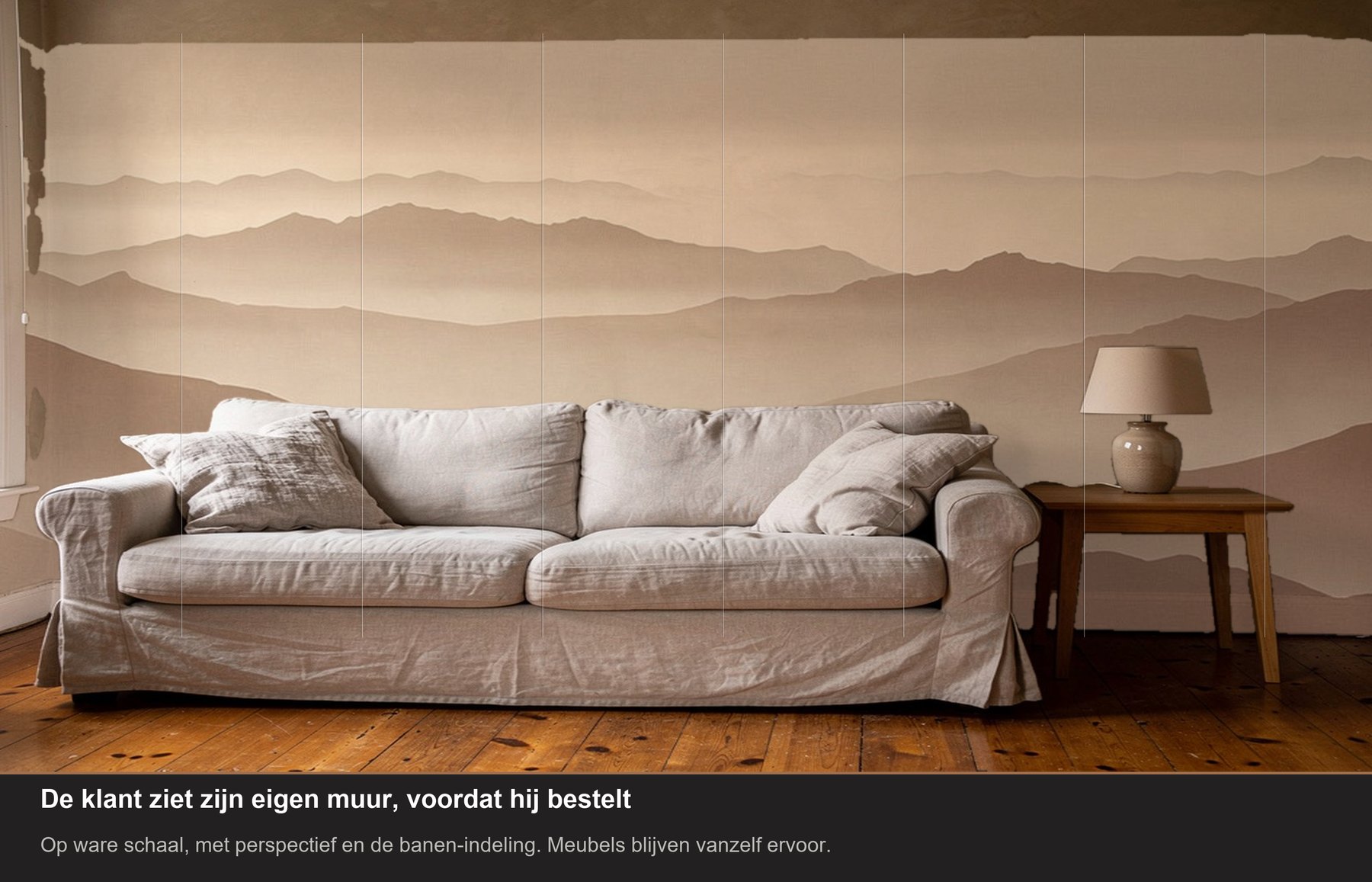
We deliberately chose a product that is made to order, carries no stock, and leaves the buyer uncertain about the result before ordering. Exactly the situation where visualisation has to make the difference.
The shop window
Your own wall, before you buy
True to scale. In your light.
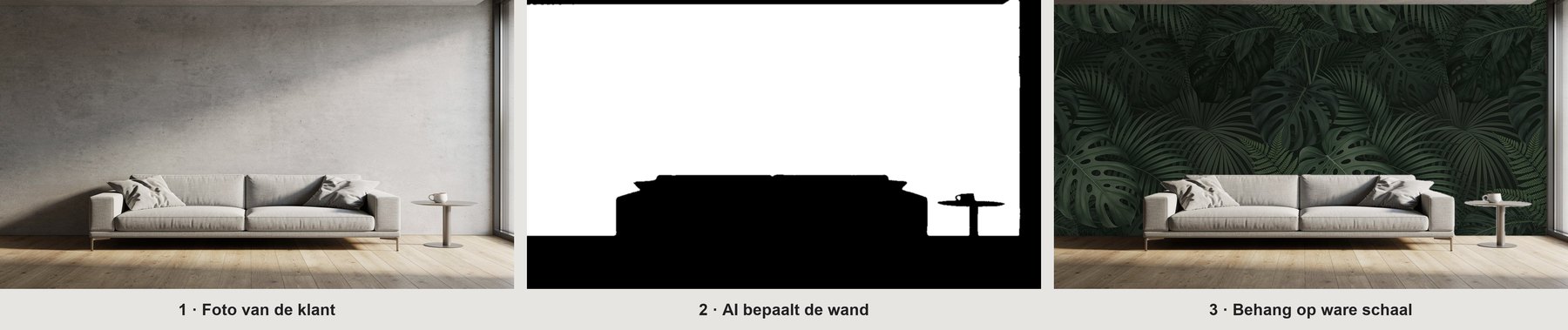
The customer photographs their own room. AI recognises which surface is the wall, and the mural is projected onto it at the dimensions the customer enters, with the perspective of the photo and with the strip layout included. Furniture stays in front of it automatically. Not a flat crop like the rest of the market shows, but the result as it will hang on the wall.
The engine room
From payment to printing press
Without intervention.
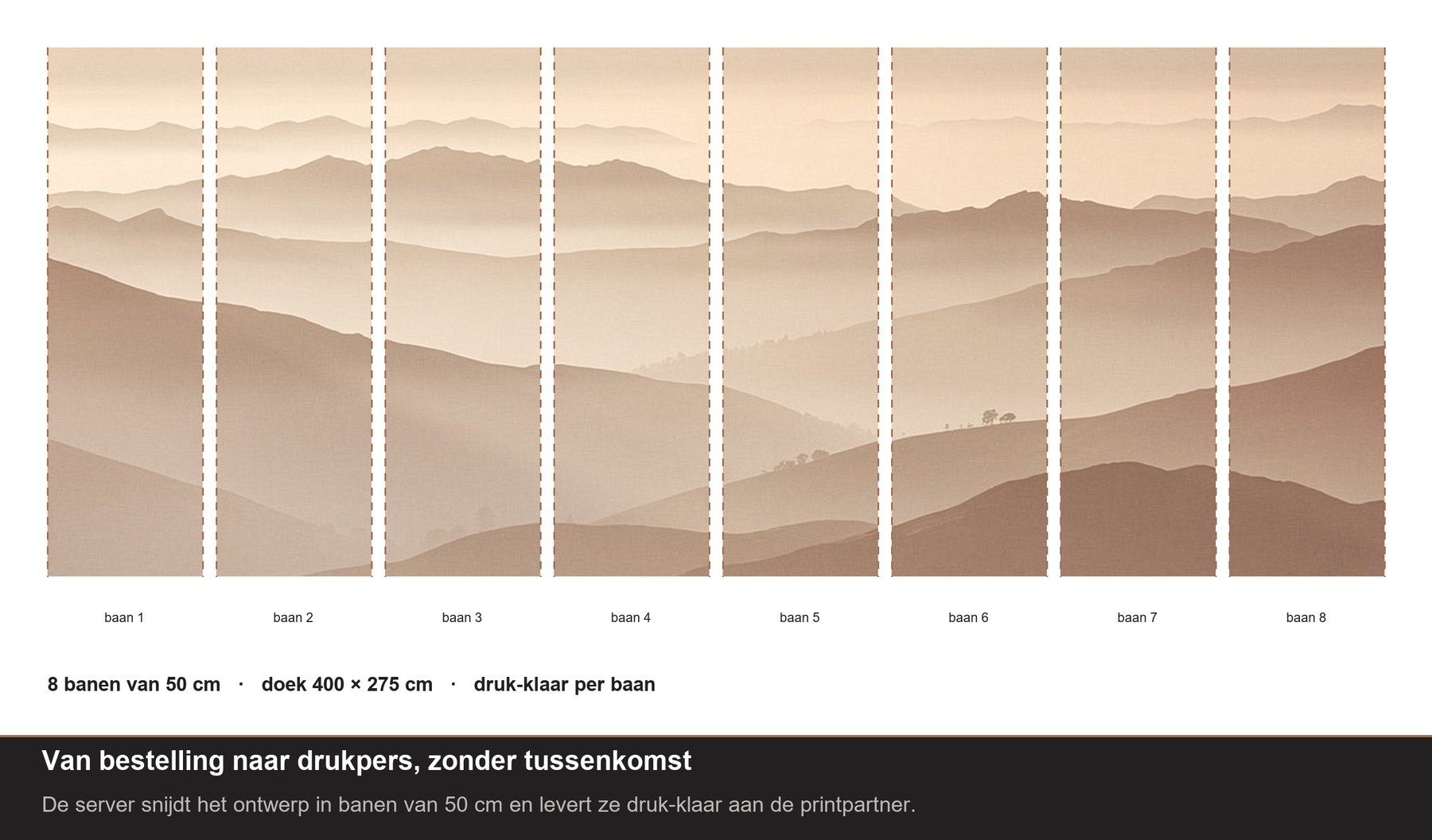
As soon as the payment comes in, the shop converts the wall dimensions into the actual material, cuts the design at full resolution into separate fifty-centimetre strips, writes the trimming instructions for the printer and passes the job to the print partner. We watch, but we do not have to touch it.
Where automation stops
A script cannot see whether it looks good.
Everything that is arithmetic is taken over by the machine, from dimensions and strips to price, print file and order flow. But whether an image works on a four-metre wall is a judgement. That stays with us.
Before it goes on sale
Every design in the collection is assessed by a 3D artist for scale and detail. Does the image hold up at four metres wide, or does it fall apart?
At the order
The generator measures whether the source has enough resolution for the size ordered and puts a warning in the print job if it does not. Better to hold an order than to ship a weak print.
After printing
Colour on a screen is not the same as colour on non-woven. We check samples against the printed reality, because that difference costs money and trust.
What we will show
We publish the figures once they exist.
The shop is built and tested, but it is not trading yet. As long as there are no real orders, there are no real figures either, and invented figures are exactly what this page is against. This is what we steer on and what we will show here once it is running.
Including when it disappoints. A testing ground that only publishes its successes is a brochure.
For your webshop
What this gives you.
We know the bill
When we say an investment pays for itself, we have run that sum on ourselves. That makes the conversation about cost and return shorter and more honest.
We run into it ourselves
A made-to-order product that cannot be returned demands a shop that is legally sound and that shows honestly what the customer will get. We ran into that ourselves, with our own name on it.
We build what we use ourselves
The visualisation, the print-ready file generation and the link to the supplier run in our own shop. You are not getting a prototype but technology we stake our own margin on.
We know when not to
If our own figures show that a component adds nothing, we say so. That is the advantage of a testing ground, we can be wrong at our own expense instead of yours.
Senior-level creativity, automated execution.
The Real Tour.
We will show you the shop from the inside. The configurator, the order flow and what happens under the bonnet when a payment comes in. Then we look at whether the same would work for your webshop.
How we work
We try it on ourselves first.
This shop is built on the same automation as our agency. Orders, invoices, image production and keeping the catalogue current are set up to run by themselves, as they do for our clients. That is how our people know where automation delivers and where it falls short.
Look inside our engine room